Yes, military calisthenics really works. Bodyweight training builds real strength, muscle and fitness, as long as the exercises get harder over time and you keep showing up. What it won’t do is transform you in four weeks without effort. Here is the honest version.
The short answer
Military calisthenics is structured bodyweight training: push-ups, squats, lunges, planks and conditioning drills, done in short daily sessions that progress week by week.
- Strength: yes, and fast for beginners.
- Muscle: yes, when you keep making exercises harder.
- Fat loss: yes, alongside sensible eating.
- 28 days: a real start, not a finish line.
What does the research say about bodyweight training?
The biggest worry people have is simple: can push-ups and squats really compete with weights? The research is more encouraging than most expect.
In a five-week trial, trained participants doing hard push-up variations gained as much strength as a bench-press group working at a similar effort (Calatayud et al., 2015).
An eight-week study then found push-ups built chest and triceps muscle and bench-press strength about as well as the bench press itself (Kikuchi & Nakazato, 2017).
The wider evidence agrees. A meta-analysis of 21 studies found lighter loads build similar muscle to heavy ones when sets are taken close to failure (Schoenfeld et al., 2017). Bodyweight work fits that model well.
Heavy lifting still wins for maximal one-rep strength. If you want to compete in powerlifting, you need a barbell. For a strong, capable, athletic body, bodyweight training is enough.
Does it improve heart health and fitness too?
Yes. Researchers modernized the Royal Canadian Air Force’s classic 5BX plan into an 11-minute bodyweight routine. Inactive adults who did it three times a week for six weeks improved their cardiorespiratory fitness (Archila et al., 2021).
Push-up capacity also tracks with heart health. Among about 1,100 male firefighters, men who could do more than 40 push-ups had a roughly 96% lower risk of cardiovascular events than those who managed fewer than 10 (Yang et al., 2019).
That is an association, not proof that push-ups prevent heart disease. Still, it shows why strength and conditioning are worth building.
Does military calisthenics really work in 28 days?
This is where honesty matters. Twenty-eight days is enough to see real progress, but not a finished body. Here is what each stage usually looks like.
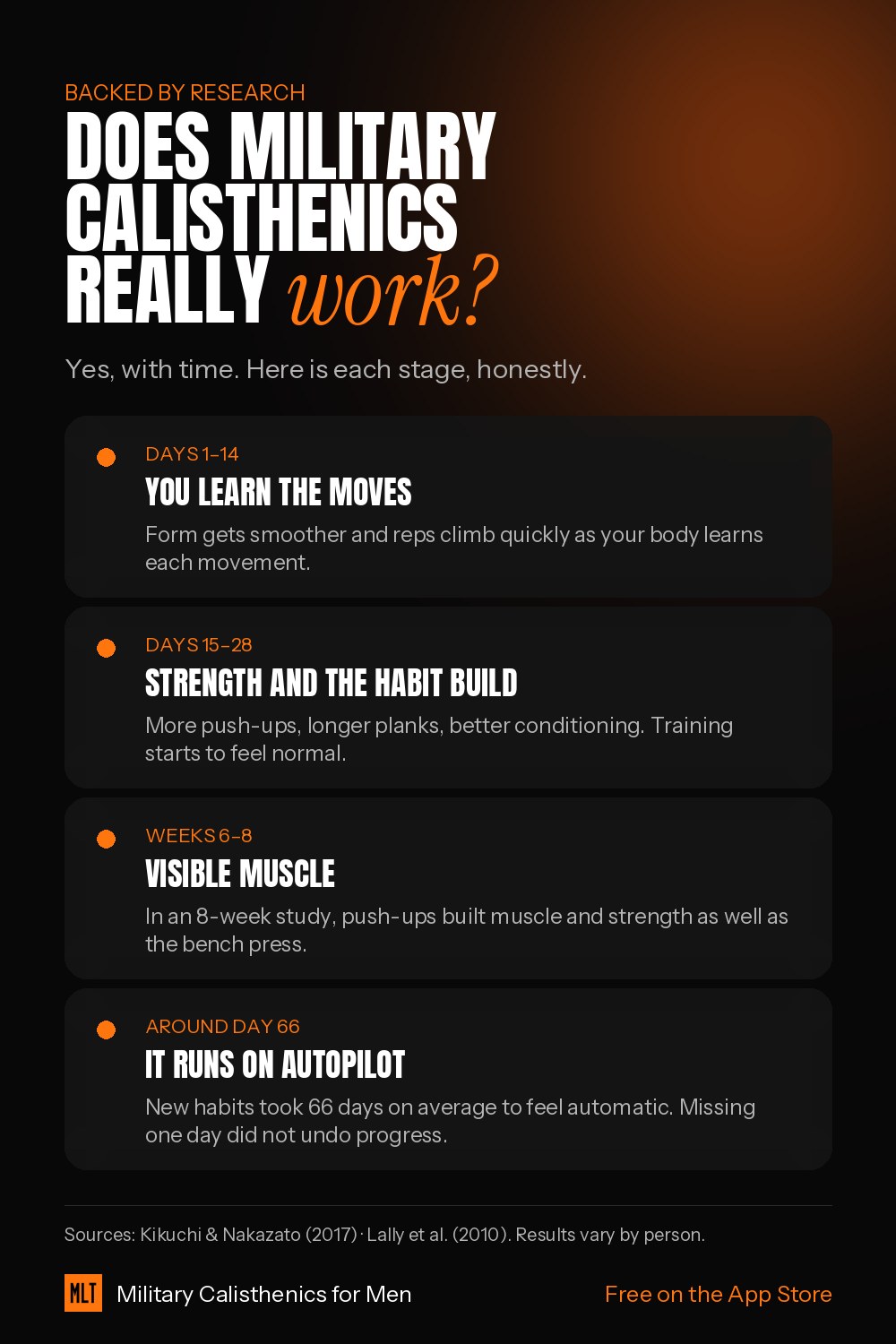
Early progress comes mostly from learning the movements, so reps climb fast in the first two weeks. Visible muscle usually needs six to eight weeks of consistent training.
The habit takes longer than most programs admit. In a well-known study, a new daily behavior took 66 days on average to feel automatic, with a range of 18 to 254 days (Lally et al., 2010).
The good news from the same study: missing one day did not meaningfully set people back. Consistency beats perfection.
That is why the 28-day challenge in our Military Calisthenics app ends with a test against Day 1, then rolls straight into the next level rather than stopping.
Does military calisthenics work for women?
Yes. A meta-analysis comparing men and women on the same programs found similar relative gains in muscle size and lower-body strength. Women actually gained slightly more relative upper-body strength (Roberts et al., 2020).
The same principles apply: progress the exercises, train consistently and recover well. If you want a plan designed for women, the Military Calisthenics Women HQ app is our women’s edition.
Does military calisthenics work for weight loss?
It helps, but it works best with your diet. A Cochrane review of 43 studies found exercise alone produced modest weight loss, while exercise plus diet beat diet alone (Shaw et al., 2006).
Higher-intensity exercise led to more weight loss in that review, and exercise improved blood pressure and blood sugar even when the scale moved slowly.
Calisthenics also helps you keep muscle while you lose fat, so you look leaner, not just smaller. Our guide on how calisthenics burns fat covers the circuits that work best.
Why does the “military” part matter?
Armies have trained with bodyweight drills for generations. Today the U.S. Army’s fitness doctrine still opens every session with a calisthenics preparation drill: lunges, squats, rows, twists and push-ups (ATP 7-22.02).
The military difference is not secret exercises. It is the structure: a set time, a set plan, clear standards and no skipping. That is exactly what most people are missing.
Is military calisthenics legit, or just marketing?
Fair question. Some “military” fitness products are sold with flashy AI-generated ads, and people online are right to be skeptical. The training method itself is completely legitimate.
For any app, check three things before paying: the App Store rating and written reviews, the price shown in the App Store, and whether workouts are led by real instructors.
Our app is free to download with optional in-app purchases, rated 4.5 stars from 114 ratings, and every session is coached by a real calisthenics instructor. One honest review said the pace felt fast for an injured beginner, so start at the easiest level.
How to make military calisthenics work for you
- Train three to five days a week, even if some sessions are only ten minutes.
- Make it harder every week: more reps, a slower tempo or a tougher variation.
- Eat enough protein and sleep seven to nine hours.
- Track check-ins so you can see the streak building.
- Start easier than you think, then let progress pull you forward.
The World Health Organization recommends muscle-strengthening activity at least two days a week for adults (WHO, 2020). Military calisthenics covers that in under 20 minutes a session.
New to all of this? Start with what military calisthenics is really like, then follow our beginner workout plan.
Want the plan done for you? Follow the 28-day program live with a real calisthenics instructor in Military Calisthenics for Men, or try the women’s HQ edition.
Frequently asked questions
Does military calisthenics really work?
Yes. Bodyweight training builds strength, muscle and fitness when you progress the exercises and train consistently. Studies show push-ups can match the bench press for strength and muscle gains.
Does military calisthenics really work in 28 days?
Partly. Four weeks is enough to get noticeably better at the movements and build the habit. Visible muscle usually takes six to eight weeks, so treat 28 days as a strong start.
Does military calisthenics work for women?
Yes. Research shows women gain muscle and lower-body strength at a similar relative rate to men, and slightly more relative upper-body strength.
Does military calisthenics work for weight loss?
It helps, especially combined with eating changes. Exercise alone produces modest weight loss, but exercise plus diet beats diet alone, and training helps you keep muscle while you lose fat.
Is military calisthenics legit?
The training method is legitimate and used by real militaries. With any app, check the App Store rating, reviews and price before paying, and favor programs with real instructors over hype.
Sources
- Calatayud J, et al. Bench press and push-up at comparable levels of muscle activity results in similar strength gains. J Strength Cond Res. 2015.
- Kikuchi N, Nakazato K. Low-load bench press and push-up induce similar muscle hypertrophy and strength gain. J Exerc Sci Fit. 2017.
- Schoenfeld BJ, et al. Strength and hypertrophy adaptations between low- vs. high-load resistance training: a systematic review and meta-analysis. J Strength Cond Res. 2017.
- Archila LR, et al. Simple bodyweight training improves cardiorespiratory fitness with minimal time commitment: a contemporary application of the 5BX approach. Int J Exerc Sci. 2021.
- Yang J, et al. Association between push-up exercise capacity and future cardiovascular events among active adult men. JAMA Netw Open. 2019.
- Lally P, et al. How are habits formed: modelling habit formation in the real world. Eur J Soc Psychol. 2010.
- Roberts BM, Nuckols G, Krieger JW. Sex differences in resistance training: a systematic review and meta-analysis. J Strength Cond Res. 2020.
- Shaw K, et al. Exercise for overweight or obesity. Cochrane Database Syst Rev. 2006.
- U.S. Army. ATP 7-22.02, Holistic Health and Fitness Drills and Exercises. 2020.
- World Health Organization. WHO guidelines on physical activity and sedentary behaviour. 2020.