

A good military calisthenics routine is the same 10 to 21 minute session at the same time every day: a short warm-up, one focused main block and a quick cool-down. Each day trains something different, and Day 7 is a longer total-body endurance session.
That’s the whole idea. No gym, no equipment, and no deciding what to do each morning. Below is the routine minute by minute, the full week exercise by exercise, the daily standard around it, and what the research says about making it stick.
What does a daily military calisthenics routine look like?
Every session has the same three parts, so your body and your head know what’s coming. Here’s a real Day 1 from our 28-day program:
Source: Military Calisthenics research, November 2026, from Week 1 of the 28-day Military Calisthenics Men – MLT program. Timed work only; add a few seconds between moves.
The warm-up loosens your neck, shoulders, wrists and hips, then raises your heart rate with high knees. The main block is where the work happens. The cool-down brings your breathing back down with a few stretches.
Most moves run for 25 to 40 seconds, against the clock rather than for a rep count. That’s what keeps a session short and makes it work for any fitness level: a beginner and a fit athlete both do 35 seconds, just at a different pace.
What’s the weekly military calisthenics routine?
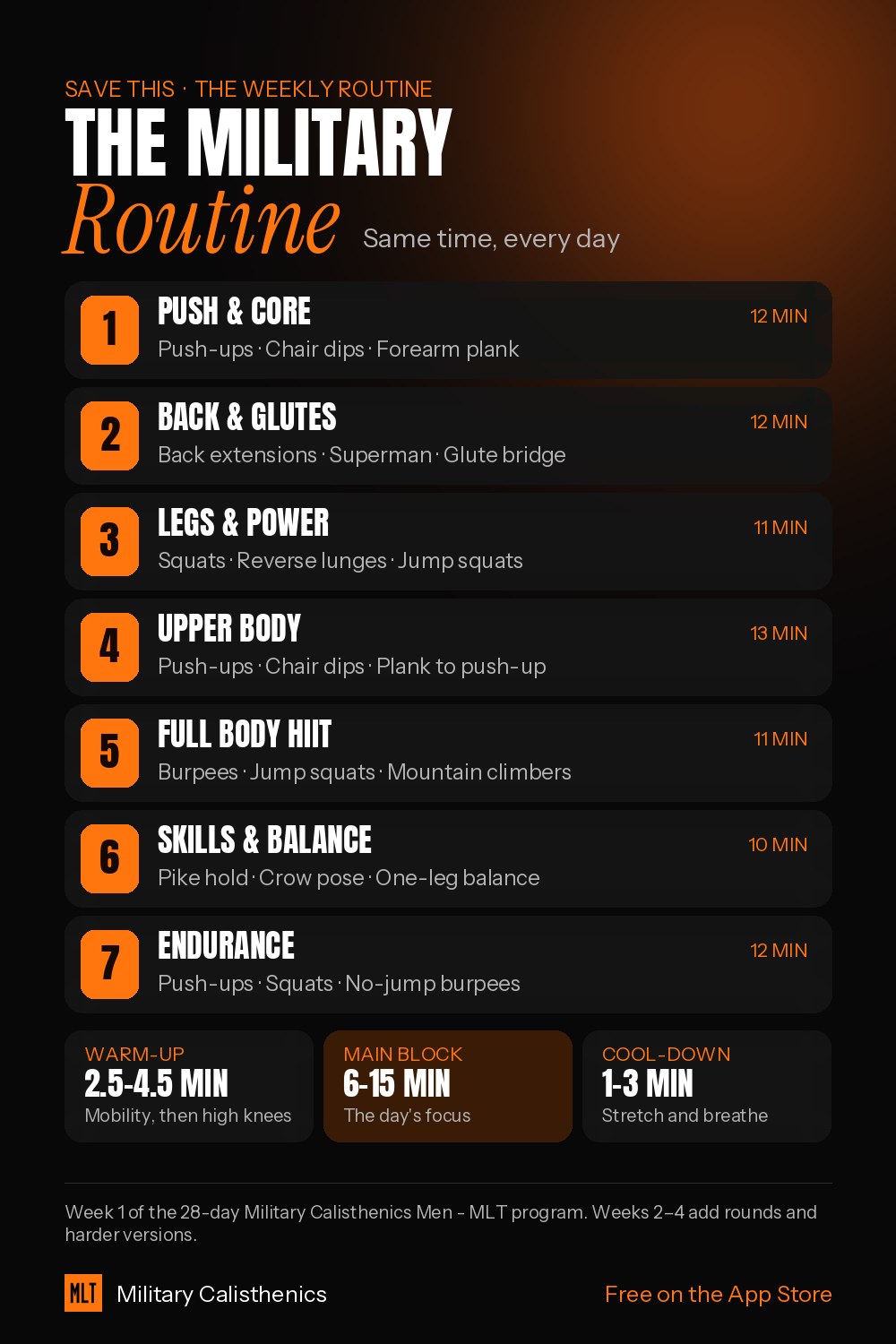
The routine changes its focus every day, so you can train daily without working the same muscles two days running:
Source: Military Calisthenics research, November 2026, from Week 1 of the 28-day Military Calisthenics Men – MLT program.
There’s no scheduled day off in this routine. Day 7 is a longer total-body endurance session instead, and it grows from 12 minutes in Week 1 to 21 minutes in Week 4.
Here’s every exercise for the first week. Open any day to see the full session:
Day 1: Push & Core Assault · 12 min
| Exercise | Time |
|---|---|
| Warm-up | |
| Neck Rotations | 30 s |
| Neck and Shoulder Roll | 35 s |
| Shoulder Circles | 35 s |
| Wrist Circles | 25 s |
| Shoulder Circles (Arms Out) | 35 s |
| High Knees Run | 30 s |
| Main block | |
| Push-ups | 2 × 35 s |
| Wide Push-ups | 2 × 35 s |
| Knee Push-ups | 30 s |
| Tricep Dips (Chair) | 2 × 30 s |
| Forearm Plank | 2 × 35 s |
| Crunches | 2 × 30 s |
| Russian Twists | 40 s |
| Back Extensions | 30 s |
| Leg Raises from Forearm Plank | 35 s |
| Cool-down | |
| Downward Dog | 20 s |
| Cobra Stretch | 15 s |
| Shoulder Stretch (Cross-arm) | 15 s |
| Triceps Stretch | 15 s |
| Child's Pose | 15 s |
Day 2: Back & Posterior Chain · 12 min
| Exercise | Time |
|---|---|
| Warm-up | |
| Neck Side Bends | 30 s |
| Shoulder Circles | 35 s |
| Wrist Circles | 25 s |
| Elbow Circles | 25 s |
| Shoulder Circles (Arms Out) | 35 s |
| High Knees Run | 30 s |
| Main block | |
| Back Extensions | 2 × 30 s |
| Superman Hold | 2 × 30 s |
| Prone Y-Pull | hold |
| Prone Leg Raises | 30 s |
| Glute Bridge | 2 × 35 s |
| Forearm Plank | 2 × 35 s |
| Russian Twists | 40 s |
| Leg Raises from Forearm Plank | 35 s |
| Cool-down | |
| Plank to Downward Dog | 35 s |
| Shoulder Stretch (Cross-arm) | 15 s |
| Triceps Stretch | 15 s |
| Lying Hamstring Stretch | hold |
| Child's Pose | 15 s |
Day 3: Legs & Power · 11 min
| Exercise | Time |
|---|---|
| Warm-up | |
| Torso Bends | 30 s |
| Hip Circles | 25 s |
| Knee Circles | 20 s |
| Ankle Circles | 25 s |
| Heel Raises | 30 s |
| Standing Forward Bend | 30 s |
| Cossack Squat Stretch | 30 s |
| Main block | |
| Bodyweight Squats | 2 × 30 s |
| Reverse Lunges | 2 × 35 s |
| Glute Bridges | 2 × 35 s |
| Lateral Lunges | 30 s |
| Jump Squats | 30 s |
| Wall Sit | 15 s |
| Glute Kickbacks (R) | 30 s |
| Glute Kickbacks (L) | 30 s |
| Mountain Climbers | 35 s |
| Cool-down | |
| Hip Flexor Stretch | 35 s |
| Behind-the-Knee Stretch | 25 s |
| Pigeon Pose | 20 s |
| Hamstring Stretch | 20 s |
| Child's Pose | 15 s |
Day 4: Upper Body Conditioning · 13 min
| Exercise | Time |
|---|---|
| Warm-up | |
| Neck Rotations | 30 s |
| Neck and Shoulder Roll | 35 s |
| Wrist Circles | 25 s |
| Elbow Circles | 25 s |
| Shoulder Circles (Arms Out) | 35 s |
| High Knees Run | 30 s |
| Standing Forward Bend | 30 s |
| Main block | |
| Push-ups | 2 × 35 s |
| Wide Push-ups | 2 × 35 s |
| Tricep Dips (Chair) | 2 × 30 s |
| Plank to Push-up | 35 s |
| Plank Shoulder Taps | 30 s |
| Forearm Plank | 2 × 35 s |
| Back Extensions | 30 s |
| Crunches | 30 s |
| Cool-down | |
| Downward Dog | 20 s |
| Wrist Stretch (Palm Down) | 15 s |
| Wrist Stretch (Palm Up) | 15 s |
| Triceps Stretch | 15 s |
| Child's Pose | 15 s |
Day 5: Full Body HIIT · 11 min
| Exercise | Time |
|---|---|
| Warm-up | |
| Neck and Shoulder Roll | 35 s |
| Shoulder Circles (Arms Out) | 35 s |
| Hip Circles | 25 s |
| Heel Raises | 30 s |
| High Knees Run | 30 s |
| Main block | |
| Burpees | 2 × 40 s |
| Jump Squats | 2 × 30 s |
| Mountain Climbers | 2 × 35 s |
| Push-ups | 2 × 35 s |
| Bodyweight Squats | 30 s |
| High Knees Run | 2 × 30 s |
| Crunches | 30 s |
| Bicycle Crunches | 30 s |
| Cool-down | |
| Shoulder Stretch (Cross-arm) | 15 s |
| Hamstring Stretch | 20 s |
| Supine Spinal Roll | 15 s |
| Pigeon Pose | 20 s |
| Child's Pose | 15 s |
Day 6: Skills & Balance · 10 min
| Exercise | Time |
|---|---|
| Warm-up | |
| Neck Rotations | 30 s |
| Shoulder Circles | 35 s |
| Hip Circles | 25 s |
| Knee Circles | 20 s |
| Heel Raises | 30 s |
| High Knees Run | 30 s |
| Main block | |
| Pike Hold (Crow Prep) | hold |
| Crow Pose | 20 s |
| Single-Leg Balance | hold |
| High Plank | 2 × hold |
| Forearm Plank | 2 × 35 s |
| Back Extensions | 30 s |
| Superman Hold | 30 s |
| Leg Raises from Forearm Plank | 35 s |
| Cool-down | |
| Downward Dog | 20 s |
| Cobra Stretch | 15 s |
| Shoulder Stretch (Cross-arm) | 15 s |
| Child's Pose | 15 s |
Day 7: Total Body Endurance · 12 min
| Exercise | Time |
|---|---|
| Warm-up | |
| Neck Rotations | 30 s |
| Neck and Shoulder Roll | 35 s |
| Shoulder Circles | 35 s |
| Shoulder Circles (Arms Out) | 35 s |
| Hip Circles | 25 s |
| Heel Raises | 30 s |
| High Knees Run | 30 s |
| Main block | |
| Push-ups | 2 × 35 s |
| Bodyweight Squats | 2 × 30 s |
| Glute Bridges | 35 s |
| No-jump Burpees | 2 × 35 s |
| Forearm Plank | 35 s |
| Russian Twists | 40 s |
| Reverse Lunges | 35 s |
| Back Extensions | 30 s |
| Bicycle Crunches | 30 s |
| Cool-down | |
| Downward Dog | 20 s |
| Cobra Stretch | 15 s |
| Hip Flexor Stretch | 35 s |
| Pigeon Pose | 20 s |
| Supine Spinal Roll | 15 s |
| Child's Pose | 15 s |
Source: the 28-day Military Calisthenics Men – MLT program, Week 1 (Recruit). Weeks 2–4 add rounds and harder versions of the same moves.
This is Week 1, the Recruit level. The full four weeks, and how each one gets harder, are laid out in our 28-day military calisthenics workout plan.
Save the week as one image for your phone or fridge:
How often should you train each muscle?
At least twice a week, and this routine does more. Across studies, training a muscle twice a week built more muscle than once a week.(1) Here’s how often Week 1 works each group:
Source: Military Calisthenics research, November 2026, from Week 1 of the Military Calisthenics Men – MLT program. Minimum: twice a week beat once a week for muscle growth (Schoenfeld, Ogborn and Krieger, Sports Medicine, 2016).
That’s why the routine can run daily: no group gets hammered two days running, but every group gets several sessions a week. More weekly sessions also tend to mean more strength, mostly because they add up to more total work:(2)
Source: Military Calisthenics research, November 2026, from a meta-analysis of 22 studies (Grgic et al., Sports Medicine, 2018).
Is there a 10-minute morning version?
Yes. On busy mornings, this short version covers your whole body with moves from Week 1. Do the main block twice:
| Part | Moves | Time |
|---|---|---|
| Warm-up | High knees, shoulder circles, hip circles | 1.5 min |
| Main block × 2 | Push-ups, squats, forearm plank, glute bridges, mountain climbers | 6 min |
| Cool-down | Downward dog, cobra stretch, child’s pose | 1 min |
Give each main-block move 30 to 35 seconds. With the moves between them, it takes about 10 minutes.
It’s a good fallback, not a replacement. On days you have 15 minutes, do the full session for that day of the week.
Is morning or evening better for the routine?
Whichever time you can keep. Strength and power naturally peak in the late afternoon, but your body adapts best at the time you train regularly.(3) Train every morning and your morning performance catches up.
| Time | Upside | Watch out for |
|---|---|---|
| Morning | Done before the day gets busy | Stiff joints: never skip the warm-up |
| Lunch | Breaks up a long sitting day | Needs a fixed slot in your calendar |
| Evening | Body is warm, strength peaks | Easier to skip after a long day |
The time matters less than keeping it the same. A fixed time becomes the cue that starts the habit.
What is the Army’s calisthenics routine?
The US Army’s version follows the same three-part shape. Its fitness manual, ATP 7-22.02, opens training with a Preparation Drill, moves on to the day’s conditioning or strength work, and closes with a Recovery Drill.(4)
| Army drill | Exercises | How it’s done |
|---|---|---|
| Preparation Drill | Bend and reach, rear lunge, high jumper, rower, squat bender, windmill, forward lunge, prone row, bent-leg body twist, push-up | 5–10 reps each |
| Conditioning Drill 1 | Power jump, V-up, mountain climber, leg-tuck and twist, single-leg push-up | 5–10 reps each |
| Recovery Drill | Overhead arm pull, rear lunge, extend and flex, thigh stretch, single-leg over, groin, calf and hamstring stretches | 20–30 s holds |
Soldiers train in formation with a leader calling the cadence, which is hard to copy at home. A timed routine does the same job: someone, or something, decides the pace for you.
Getting ready for the real thing? Our guide to military PT at home covers the Army Fitness Test events and how to train for them.
How should the routine change as you get fitter?
The routine stays the same shape. What changes is how much work fits inside it:
Source: the 28-day Military Calisthenics Men – MLT program. Calories are the app’s estimates for a 75 kg (165 lb) person.
Week by week you add rounds, then harder versions of the same moves, such as diamond push-ups and jump squats. Sessions grow a little, from 10–13 minutes to 16–21.
After four weeks, start again at a harder level rather than stopping. That second round is where the visible change usually starts.
What should you do around the workout for the best results?
The workout is 10 to 21 minutes. The other 23 hours decide how much it pays off. Our free PDF sets a daily standard of five boxes to tick:
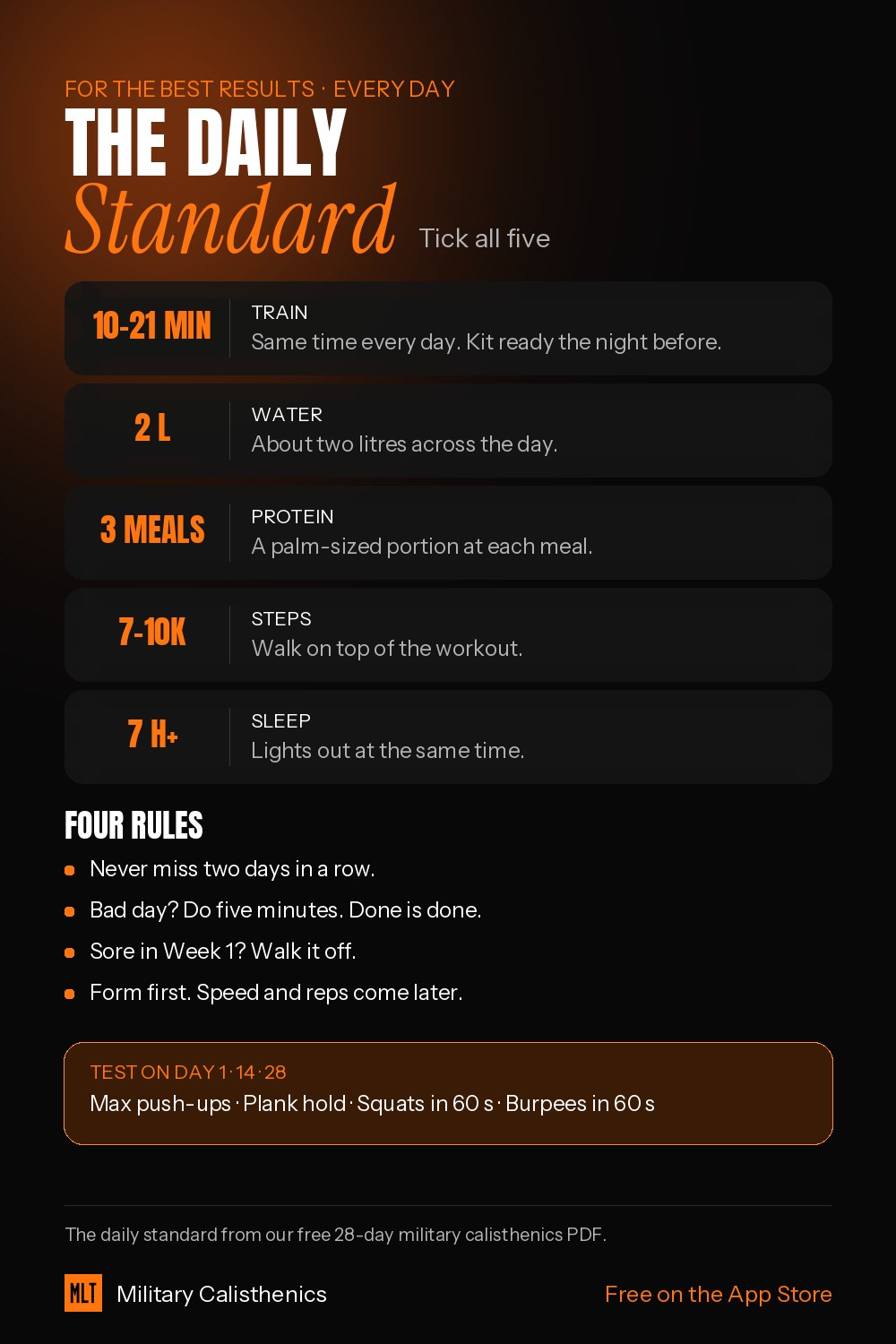
Protein at every meal protects the muscle you’re building. Gains tend to level off at about 1.6 g per kg of body weight a day, and a palm-sized portion at three meals is a simple way to aim for it.(5)
Steps on top of the workout add up fast. In a review of 15 studies, people who walked more each day had a much lower risk of early death:(6)
Source: Paluch AE, et al. Daily steps and all-cause mortality: a meta-analysis of 15 international cohorts. Lancet Public Health, 2022. Hazard ratios 0.60, 0.55 and 0.47 vs the lowest quarter.
Seven hours of sleep or more is the adult minimum sleep experts recommend.(7) Recovery is when the strength gets built, so a fixed lights-out time is part of the routine too.
About two litres of water across the day keeps sessions comfortable, especially on HIIT days.
How do you know the routine is working?
Test yourself on Day 1, Day 14 and Day 28, fresh and before that day’s session, with the same form each time. Numbers beat the mirror:
| Test | How |
|---|---|
| Push-ups | Max in one set, good form |
| Forearm plank | Hold time in seconds |
| Squats | As many as you can in 60 s |
| Burpees | As many as you can in 60 s |
| How you feel | Rate it 1 to 10 |
Optional: body weight, waist at the navel and resting heart rate on waking, measured at the same time of day before breakfast. Reps usually climb first, in the first two to three weeks.
How do you adjust it for your age or level?
- Complete beginner: start every move in its easiest version and repeat Week 1 before moving on. Our beginner’s guide shows each one.
- Over 40 or 50: keep the warm-up, swap jumps for low-impact versions and add balance work. See the guide for men over 50.
- Women: the same routine works. Only the starting versions and progressions change.
- Short on time: use the 10-minute morning version and do the full session on two or three days a week.
How do you make it a routine you actually keep?
This is the part that matters most, and it’s the real point of the “military” label. Soldiers don’t train because they feel like it. Their day is built so training happens.
New habits take longer than most people think. Here’s what the research on exercise habits found:
New gym members needed at least four sessions a week for six weeks before exercise became a habit, and consistency was the strongest predictor.(8) An analysis of over 12 million gym check-ins found a gym habit typically takes months, not a set number of days.(9)
So one 28-day program starts the habit, and the second one usually locks it in:
Source: Military Calisthenics research, November 2026, from a habit-formation study of 96 volunteers (Lally et al., European Journal of Social Psychology, 2010).
Five rules that make it automatic sooner, the same ones printed in our PDF:
- Same time, same place. Right after you wake up, or right after work. The time is the trigger.
- Lay it out the night before. A mat and a water bottle on the floor remove one decision.
- Bad day? Do five minutes. Done is done. Showing up keeps the habit alive even when the workout is short.
- Never miss twice. One missed day is normal. In a study of 61,293 gym members, rewarding people for coming back after a miss was the most effective nudge.(10)
- Track the streak. A calendar you can see turns a workout into a chain you don’t want to break.
The mindset behind it is in our guide to building military discipline.
Can you do military calisthenics every day?
Yes, because the routine rotates. Push, pull, legs, conditioning and skills days take turns, so each muscle group gets time to recover while you train something else.
Some soreness in the first week is normal. If a muscle is still sore after 48 hours, swap that day for an easy walk and the cool-down stretches, then carry on.
What if you have to pause the routine?
Life happens: travel, illness, a busy month. The good news is that strength fades slowly. In a 32-week study, strength gained from training was largely kept even after people stopped completely.(11)
Doing just a third of the original training kept muscle size in younger adults, though older adults needed more.
So on a hard week, doing the 10-minute morning version two or three times is a sensible way to hold on, then pick the full routine back up.
Want it printed or guided?
Prefer paper? Our free 28-day military workout PDF has every session with a tracker, ready to print.
Prefer someone to run it for you? The app sets the timer, picks the day and shows every move on video.

Make the routine automatic. Open Military Calisthenics Men – MLT, press play, and a real instructor walks you through your first 15-minute session. The app picks the level, the timing and the next step.
Try 3 days freeThen $29.99 a year. Cancel anytime.
 For women: Military Calisthenics Women – HQ→
Frequently asked questions
What is a good military calisthenics routine?
A short daily session at a fixed time: a 2.5 to 4.5 minute warm-up, a 6 to 15 minute main block and a 1 to 3 minute cool-down. Each weekday trains a different focus, and Day 7 is a longer total-body endurance session.
How long should a military calisthenics routine be?
10 to 21 minutes, including the warm-up and cool-down. Beginners start around 10 to 13 minutes a day, and sessions grow to 16 to 21 minutes by the fourth week as rounds are added.
Can you do military calisthenics every day?
Yes, if the days rotate. A routine that alternates push, pull, legs, conditioning and skills lets each muscle recover while you train another. If something stays sore after 48 hours, walk that day instead.
What is the Army calisthenics routine?
The Army opens training with a Preparation Drill of ten moves, including the rear lunge, squat bender, windmill and push-up, then does conditioning drills, and finishes with a Recovery Drill of stretches held 20 to 30 seconds.
Is it better to do the routine in the morning or evening?
Strength peaks naturally in the late afternoon, but your body adapts best at whatever time you train regularly. So pick the time you can repeat every day; a fixed time also works as the cue that builds the habit.
How long does it take for a workout routine to become a habit?
Longer than one program. New gym members needed at least four sessions a week for six weeks, and a median daily habit took 66 days to feel automatic. Run the 28-day routine twice to lock it in.
Can women follow this military calisthenics routine?
Yes. The structure and moves are the same for women; only the starting versions and progressions change. Start with the easier version of each move and build up week by week.
Sources
- Schoenfeld BJ, Ogborn D, Krieger JW. (2016). Effects of resistance training frequency on measures of muscle hypertrophy: a systematic review and meta-analysis. Sports Med.
- Grgic J, et al. (2018). Effect of resistance training frequency on gains in muscular strength: a systematic review and meta-analysis. Sports Med.
- Chtourou H, Souissi N. (2012). The effect of training at a specific time of day: a review. J Strength Cond Res.
- U.S. Army. (2020). ATP 7-22.02: Holistic Health and Fitness Drills and Exercises. Department of the Army.
- Morton RW, et al. (2018). A systematic review, meta-analysis and meta-regression of the effect of protein supplementation on resistance training-induced gains in muscle mass and strength. Br J Sports Med.
- Paluch AE, et al. (2022). Daily steps and all-cause mortality: a meta-analysis of 15 international cohorts. Lancet Public Health.
- Watson NF, et al. (2015). Recommended amount of sleep for a healthy adult: a joint consensus statement of the AASM and SRS. Sleep.
- Kaushal N, Rhodes RE. (2015). Exercise habit formation in new gym members: a longitudinal study. J Behav Med.
- Buyalskaya A, et al. (2023). What can machine learning teach us about habit formation? Evidence from exercise and hygiene. Proc Natl Acad Sci U S A.
- Milkman KL, et al. (2021). Megastudies improve the impact of applied behavioural science. Nature.
- Bickel CS, Cross JM, Bamman MM. (2011). Exercise dosing to retain resistance training adaptations in young and older adults. Med Sci Sports Exerc.