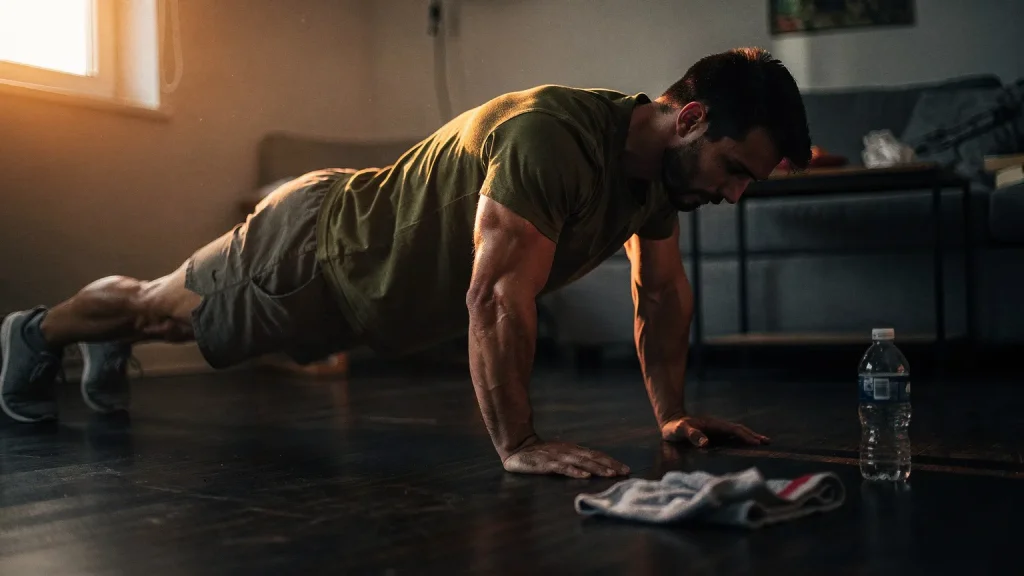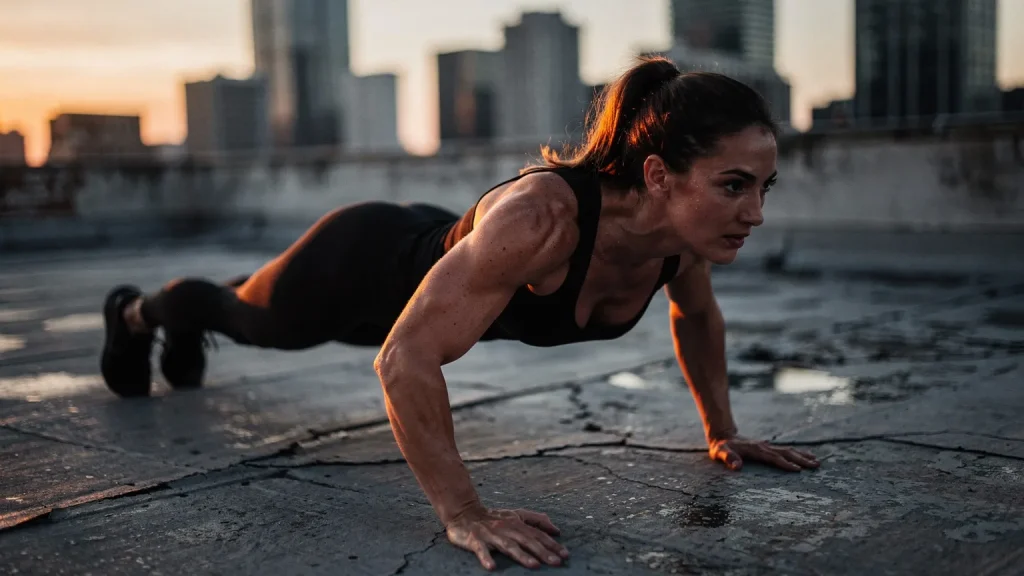
Calisthenics can build as much muscle as gym training for most people, as long as the exercises get progressively harder and sets are taken close to fatigue. The gym wins for maximal strength and for training legs heavily over the long term.
Here’s what the studies actually compare.
Can bodyweight training build as much muscle as weights?
For the upper body, the evidence is strong. One study matched push-ups and bench press at similar muscle activation and found similar strength gains over five weeks.(1)
Another trained men with low-load push-ups or bench press for eight weeks. Both groups gained similar muscle size and strength.(2)
The reason is simple: muscles respond to effort and tension, not to the tool. A meta-analysis found light and heavy loads build similar muscle when sets go close to failure.(3)
Where does the gym win?
Three places:
- Maximal strength. Lifting heavy is the best way to get better at lifting heavy.
- Legs at advanced levels. Once squats get easy, it’s hard to load legs enough without weights or single-leg work.
- Precise progression. Adding 2.5 kg is easier than finding the next push-up variation.
If your goal is a big deadlift, go to the gym. If your goal is a strong, capable body, calisthenics covers most of it.
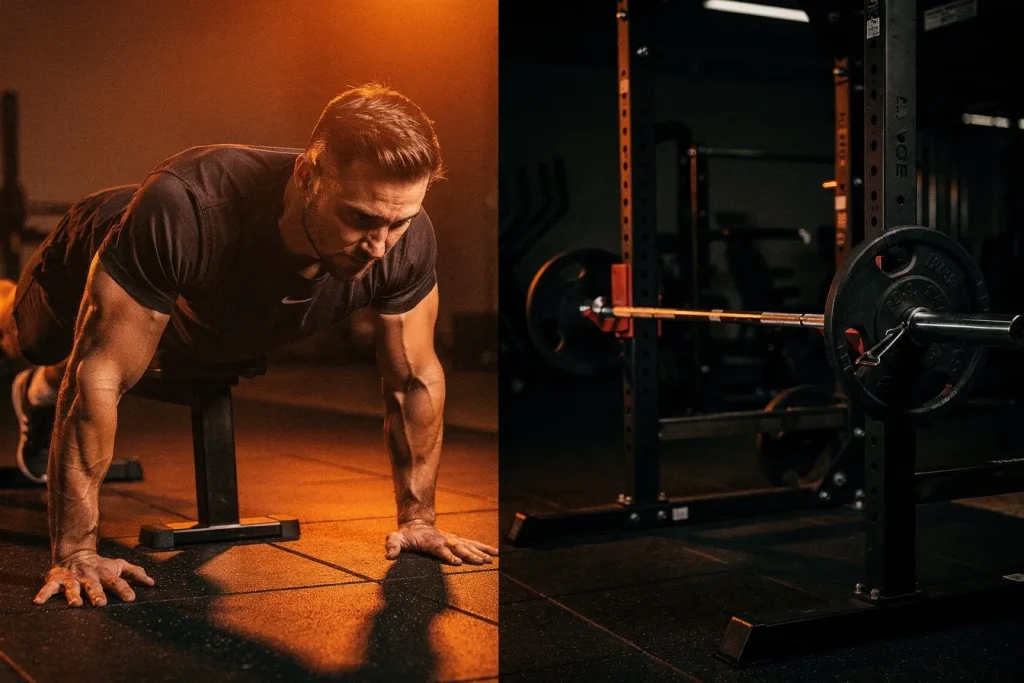
Do hormones from heavy lifting matter?
Less than people think. A study of trained men found that neither load nor the short-term hormone spikes after training determined muscle or strength gains.(4)
You don’t need heavy weights to “unlock” growth. You need consistent, hard sets.
Which is better for real life?
| Factor | Calisthenics | Gym |
|---|---|---|
| Cost | Free or low cost | Membership fees |
| Time | Train anywhere, 15 min | Travel + session |
| Muscle building | Very good with progression | Very good |
| Max strength | Good | Best |
| Body control and endurance | Best | Good |
| Consistency | Easier to repeat daily | Easier to skip |
For most busy people, the bigger factor is consistency. The best program is the one you’ll still be doing in six months.
What does a muscle-building calisthenics plan need?
- Progression: harder variations, more rounds, slower reps
- Effort: finish most sets one or two reps short of failure
- Frequency: each muscle about twice a week
- Protein: around 1.6 g per kg of body weight daily
Read how to build muscle at home, or try a push-pull-legs split.
Can you combine both?
Yes, and many people do. Bodyweight training at home on weekdays, the gym once or twice for heavy legs. Neither cancels the other.
If you’re deciding between styles of training, also see military calisthenics vs CrossFit. Choosing a program to follow? Here’s our honest comparison of the best military calisthenics apps.
Want to see why the method works at all? Read does military calisthenics really work.
Gym-level results, from your living room. MLT puts the whole 28-day program on your iPhone, with every session led on video by a real calisthenics instructor. No gym, no equipment, 10–21 minutes a day.
Try 3 days freeThen $29.99/year. Cancel anytime in iPhone Settings.
For women: the HQ edition
Frequently asked questions
Is calisthenics better than the gym for building muscle?
Not better, but comparable for most people. Studies show push-ups and bench press build similar muscle and strength when effort is matched. The gym is better for maximal strength.
Can you get big with calisthenics only?
You can build a lot of muscle with calisthenics if you progress the exercises and eat enough. Very large legs are harder without added load.
Is calisthenics or gym better for beginners?
Calisthenics is often easier to start: it’s free, you can train at home, and it teaches body control first. Beginners progress well with either.
Do I need to lift weights to build muscle?
No. Muscle responds to hard effort, not heavy load specifically. Bodyweight training taken close to failure builds muscle effectively.
Sources
- Calatayud J, et al. (2015). Bench press and push-up at comparable levels of muscle activity results in similar strength gains. J Strength Cond Res.
- Kikuchi N, Nakazato K. (2017). Low-load bench press and push-up induce similar muscle hypertrophy and strength gain. J Exerc Sci Fit.
- Schoenfeld BJ, et al. (2017). Strength and hypertrophy adaptations between low- vs. high-load resistance training: a systematic review and meta-analysis. J Strength Cond Res.
- Morton RW, et al. (2016). Neither load nor systemic hormones determine resistance training-mediated hypertrophy or strength gains in resistance-trained young men. J Appl Physiol.