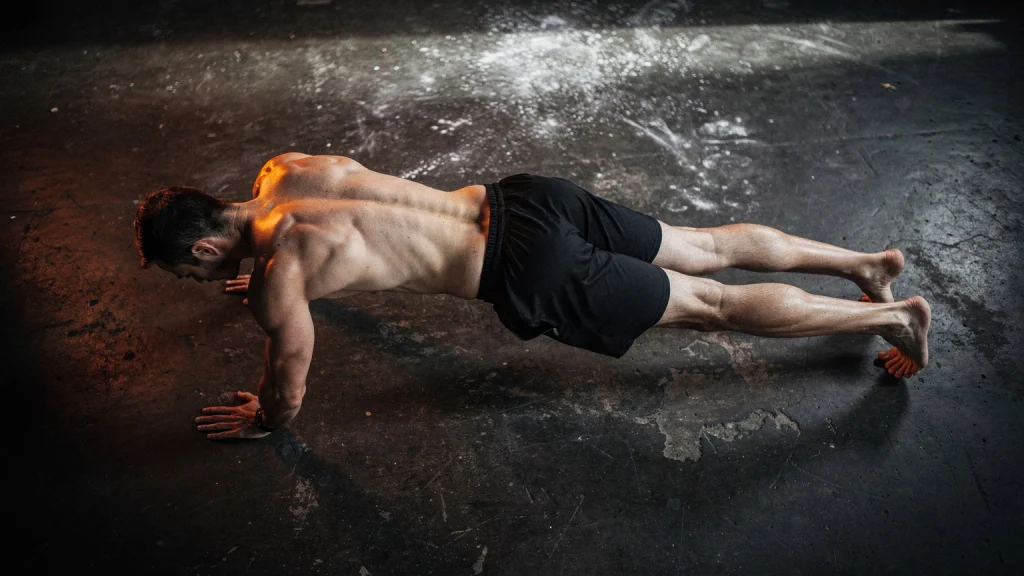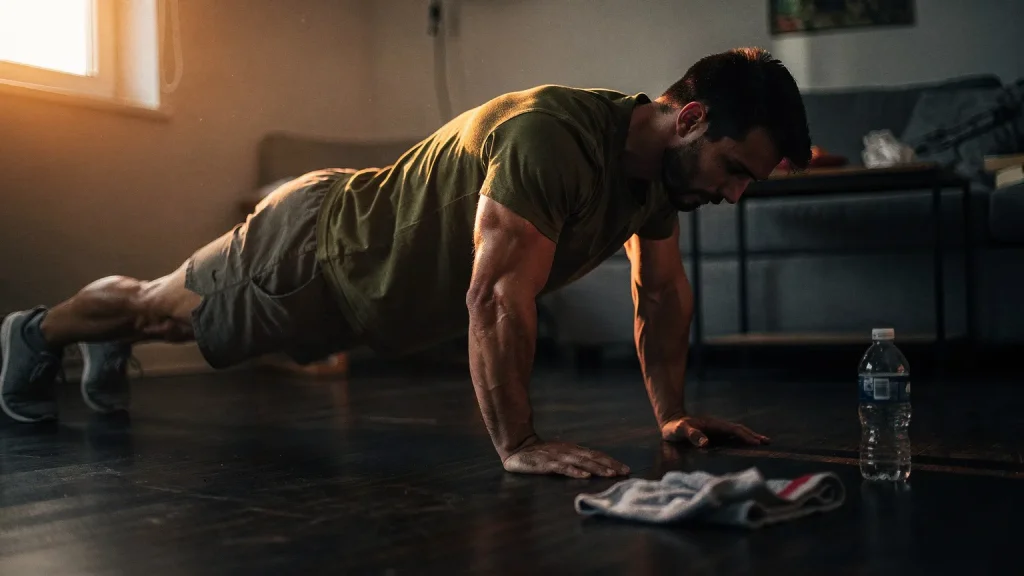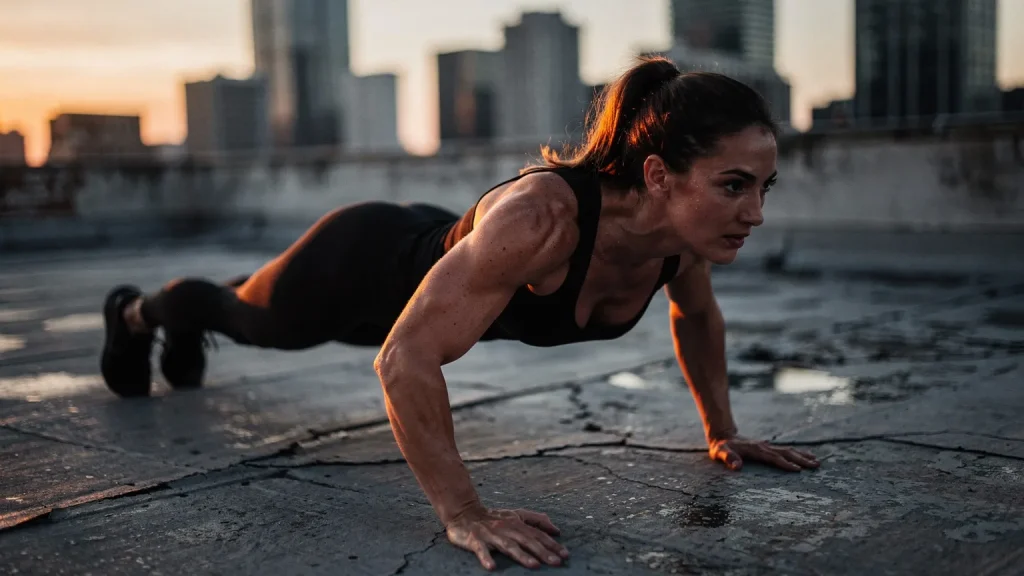
Military calisthenics exercises are simple bodyweight moves (push-ups, squats, lunges, planks, burpees and jumping drills) done with strict form and a set structure. There are no machines. You and the floor are the gym.
This is the full list, grouped by what each move does. Each one has a single form cue and an easier and harder version.
What exercises do soldiers actually do?
The U.S. Army’s fitness drills are built from a short list of movements. Its Preparation Drill alone has 10 exercises used to warm up before every session.(1)
The full Army manual adds drills for strength, mobility and conditioning.(2) Almost all of them fit into five groups: push, pull, legs, core and conditioning.
Short on time? These are the 5 exercises that matter most.
Push exercises: chest, shoulders and arms
| Exercise | Form cue | Easier | Harder |
|---|---|---|---|
| Push-up | Body moves as one plank | Knee or incline push-up | Decline push-up |
| Wide push-up | Elbows at 45°, not flared flat | Incline wide push-up | Slow 3-second lowering |
| Hand-release push-up | Chest to floor, lift hands, press up | Pause at the bottom | More reps in 2 minutes |
| Chair dips | Shoulders down, away from ears | Bent knees | Straight legs, feet raised |
| Pike push-up | Hips high, head toward floor | Smaller range | Feet on a chair |
The push-up is the backbone. Research shows push-ups can build strength about as well as the bench press at comparable effort.(3)
Get the details right with our guide to military push-up form. Stuck on low reps? Follow the push-up progression from zero to 50.
Pull exercises: back and rear shoulders
Pulling is the hardest gap to fill without equipment. These moves cover it:
- Back extensions: lie face down, lift chest and legs a few inches, squeeze your glutes
- Superman hold: the same position, held for time
- Prone Y-pull: arms in a Y, thumbs up, lift and squeeze your shoulder blades
- Doorframe or table rows: pull your chest toward a sturdy edge
- Pull-ups: the gold standard if you have a bar
No bar at home? Here are 6 back exercises without a pull-up bar.
Leg exercises: quads, glutes and hamstrings
| Exercise | Form cue | Easier | Harder |
|---|---|---|---|
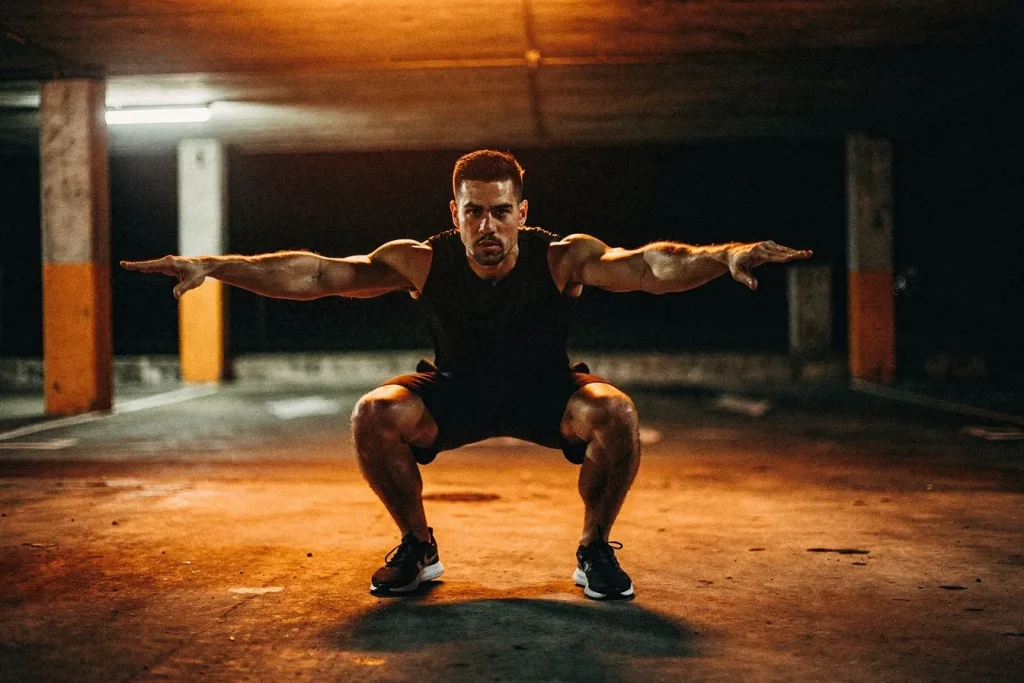
| Bodyweight squat | Sit back, knees track over toes | Squat to a chair | Pause at the bottom |
| Reverse lunge | Step back, front shin vertical | Hold a wall | Slow lowering |
| Glute bridge | Drive through heels, ribs down | Shorter hold | Single leg |
| Wall sit | Thighs parallel, back flat | Higher position | Longer hold |
| Jump squat | Land soft and quiet | Squat to calf raise | Continuous reps |
Squats are where most people cheat depth. Our squat form guide shows how to squat like a soldier.
Core exercises: the military favorites
- Forearm plank: squeeze glutes, push the floor away
- Flutter kicks: lower back pressed down, small fast kicks
- Leg raises: lower slowly, stop before your back arches
- Russian twists: rotate from the ribs, not just the arms
- Plank shoulder taps: keep the hips still
The plank is now part of the U.S. Army Fitness Test, which replaced the old leg tuck.(4) Find out how long you should hold a plank.
Flutter kicks are the classic military core drill, and most people do them wrong.
Conditioning exercises: heart and lungs
These raise your heart rate fast and burn the most energy per minute:
- Burpees: the full-body test every recruit remembers
- Mountain climbers: knees drive under the hips, back flat
- High knees: run in place, knees to hip height
- Side straddle hop: the military name for a jumping jack
Learn how to do burpees the military way, why mountain climbers earn their place, and what a side straddle hop really is.
How should you combine these exercises?
Don’t do all of them every day. Rotate the focus: push one day, pull and posterior the next, then legs, then conditioning.
That’s how a structured military calisthenics workout plan works, and why each muscle gets rest between sessions.
The Army starts every session with a set warm-up. Ours is based on the Army preparation drill.
Learn every move from a real instructor. MLT puts the whole 28-day program on your iPhone, with every session led on video by a real calisthenics instructor. No gym, no equipment, 10–21 minutes a day.
Try 3 days freeThen $29.99/year. Cancel anytime in iPhone Settings.
For women: the HQ edition
Frequently asked questions
What are the main military calisthenics exercises?
Push-ups, squats, lunges, planks, flutter kicks, burpees, mountain climbers and jumping jacks (side straddle hops). Back extensions and pull-ups cover pulling. Most military routines are built from these.
Can you build muscle with only these exercises?
Yes, if they get harder over time. Studies show bodyweight moves like push-ups build muscle similarly to weights when sets are taken close to failure.
How many exercises should one workout have?
Six to nine is plenty. Pick moves for one or two focus areas, do two rounds, and keep rest short. Quality beats variety.
Which exercise should beginners learn first?
The push-up and the squat. Learn them with a full range of motion before adding speed or jumping moves like burpees.
Sources
- U.S. Army. (2020). ATP 7-22.02: Holistic Health and Fitness Drills and Exercises. Department of the Army.
- U.S. Army. (2020). FM 7-22: Holistic Health and Fitness. Department of the Army.
- Calatayud J, et al. (2015). Bench press and push-up at comparable levels of muscle activity results in similar strength gains. J Strength Cond Res.
- U.S. Army. (2025). Army introduces new fitness test for 2025. army.mil.