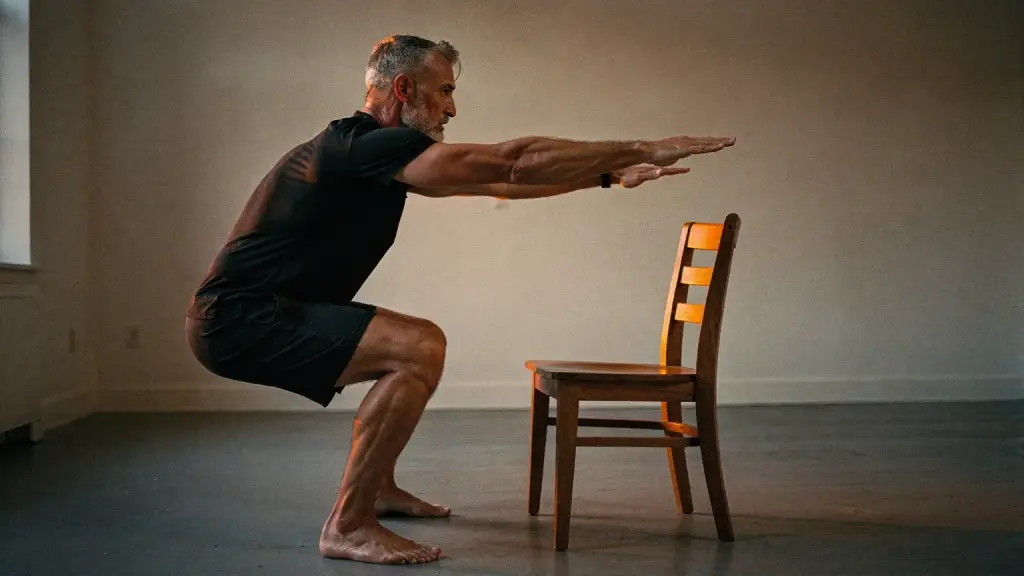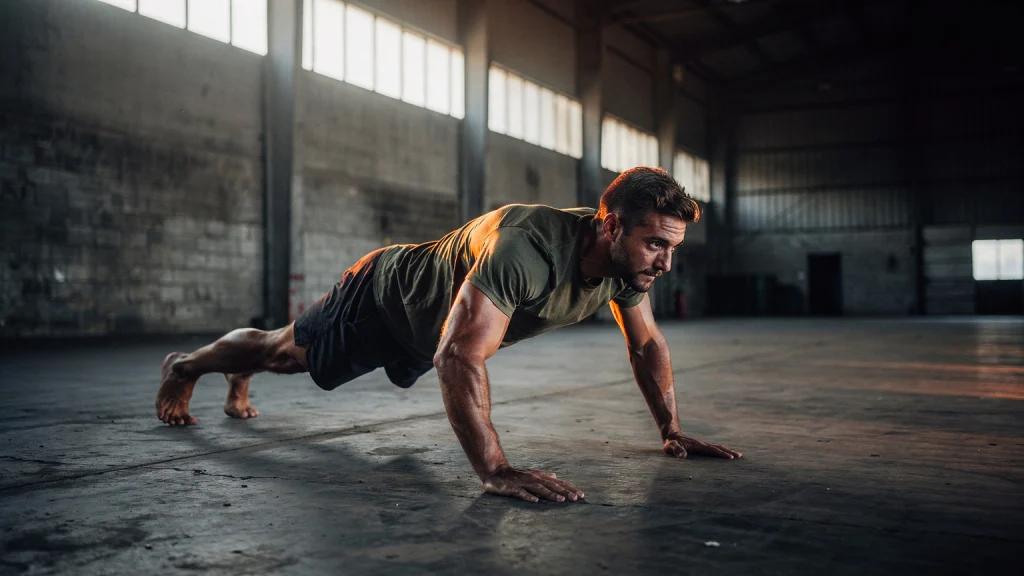

Military calisthenics is bodyweight training modeled on how armed forces condition their people: short, structured sessions of push-ups, squats, lunges, planks and conditioning drills that get a little harder every week. No gym and no equipment, just a plan and the discipline to follow it.
The moves are the ones you already know. What’s different is the packaging: a fixed daily session, timed intervals and a plan that adds work every week.
Military calisthenics in numbers
Here’s what a real 28-day program looks like when you count everything in it, from the sessions in Military Calisthenics Men – MLT:
The short version: about 15 minutes a day, 62 different moves, and three-quarters more work by the last week than the first.
Is it as hardcore as it sounds?
Usually not. The word “military” makes people picture a drill sergeant, but beginner sessions are short and every exercise has an easier version.
The difficulty comes from repetition, not extreme moves. Day 1 is manageable. Day 28 feels hard because you’ve trained for a month, not because anything is dangerous.
People who’ve done ROTC or basic training often call it the fittest they’ve ever been. That came from showing up every day, not from any one workout.
What does a session actually look like?
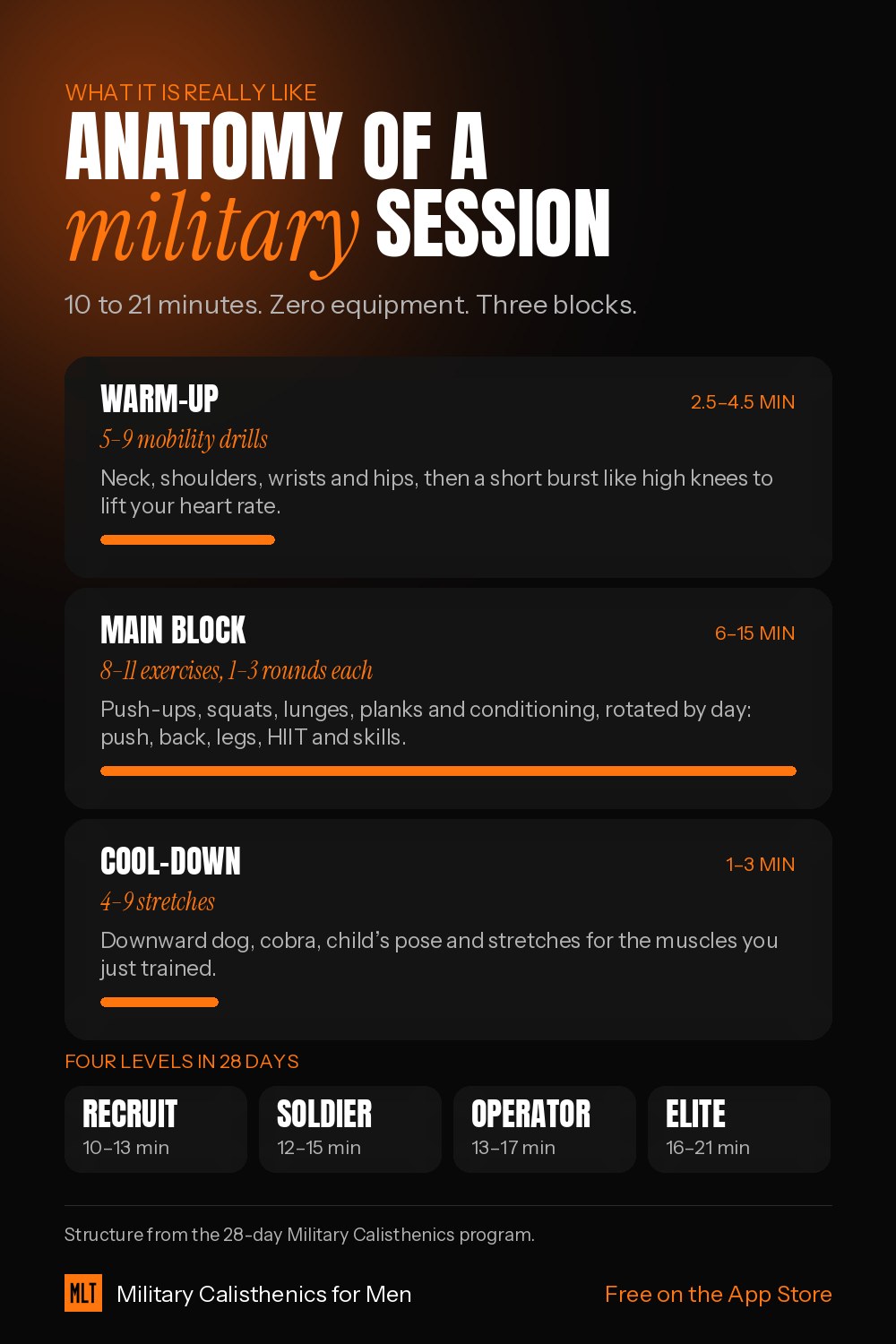
Every session has the same three parts, so you always know what’s coming:
| Part | Time | What happens |
|---|---|---|
| Warm-up | 2.5–4.5 min | Neck, shoulder, wrist and hip mobility, then high knees |
| Main block | 6–15 min | 8 to 11 moves for one to three rounds |
| Cool‑down | 1–3 min | Downward dog, cobra, child’s pose, slow breathing |
The day’s focus rotates through push and core, back and glutes, legs, upper body, HIIT, skills and a longer total-body endurance session on Day 7.
Which exercises does it use?
Almost everything comes back to five foundations:
- Push-up for chest, shoulders and triceps
- Squat for quads, glutes and mobility
- Lunge for single-leg strength and balance
- Plank for a stable core
- Burpee or mountain climber for conditioning
Push-ups and forearm planks are the backbone: each shows up 14 times in the 28 days. The US Army’s own Preparation Drill uses ten moves, including the rear lunge, squat bender, windmill, prone row and push-up.(1)
The full list with form cues is in our exercise guide.
How does a 28-day program step up?
Each week is a level. Sessions get a little longer, but the bigger change is how much work you fit into them:
Source: the 28-day Military Calisthenics Men – MLT program. Calories are the app’s estimates for a 75 kg (165 lb) person.
| Week | Level | Session | What changes |
|---|---|---|---|
| 1 | Recruit | 10–13 min | Learn the core moves |
| 2 | Soldier | 12–15 min | More rounds, new variations |
| 3 | Operator | 13–17 min | Harder variations |
| 4 | Elite | 16–21 min | Peak volume, final test |
Day by day, the sessions climb in small steps, and the Day 7 endurance session grows the most:
See all 28 sessions
| Day | Session | Min |
|---|---|---|
| 1 | Push & Core Assault | 12 |
| 2 | Back & Posterior Chain | 12 |
| 3 | Legs & Power | 11 |
| 4 | Upper Body Conditioning | 13 |
| 5 | Full Body HIIT | 11 |
| 6 | Skills & Balance | 10 |
| 7 | Total Body Endurance | 12 |
| 8 | Push & Core Volume | 15 |
| 9 | Back & Posterior Power | 14 |
| 10 | Legs & Explosive Power | 14 |
| 11 | Upper Strength Compound | 15 |
| 12 | Combat HIIT | 14 |
| 13 | Skills & Tactical Endurance | 12 |
| 14 | Total Body Endurance — Build | 13 |
| 15 | Push & Core Warfare | 17 |
| 16 | Back & Posterior Domination | 15 |
| 17 | Legs & Power Surge | 15 |
| 18 | Upper Strength Elite | 17 |
| 19 | Tactical HIIT | 16 |
| 20 | Skills & Battlefield Endurance | 13 |
| 21 | Total Body Endurance — Push | 16 |
| 22 | Push & Core Annihilation | 19 |
| 23 | Back & Posterior Supremacy | 18 |
| 24 | Legs & Power Maximum | 16 |
| 25 | Upper Strength Final | 20 |
| 26 | All-Out HIIT | 19 |
| 27 | Skills & Endurance Final | 16 |
| 28 | Total Body — Final Challenge | 21 |
Source: the 28-day Military Calisthenics Men – MLT program, warm-up and cool-down included.
Week 1 is laid out day by day in our beginner guide.
Why does military calisthenics work?
Four things do the work, and none of them is a secret exercise.
1. The plan keeps adding work. Muscles adapt to what you ask of them, then stop adapting unless you ask for more. That’s why the program adds rounds every week instead of repeating the same session.
2. Your bodyweight is enough load. In controlled trials, push-ups built bench-press strength about as well as the bench press itself.(2) (3) Across 21 studies, lighter loads built as much muscle as heavy ones when sets went close to failure.(4)
3. Intervals train heart and muscle together. A modern version of the classic 5BX plan, just 11 minutes of bodyweight intervals three times a week, raised aerobic fitness in six weeks. Every participant completed every session.(5)
4. Structure beats motivation. A new daily habit took a median of 66 days to feel automatic.(6) A fixed time and a session that’s already decided make those days easier to stack, and training the same way daily is the military part.
Here’s how much those changes measured in studies:
Sources: Calatayud J, et al. J Strength Cond Res, 2015 · Archila LR, et al. Int J Exerc Sci, 2021 · Kikuchi N, Nakazato K. J Exerc Sci Fit, 2017 · Westcott WL. Curr Sports Med Rep, 2012.
The full evidence, including what 28 days can’t do, is in does military calisthenics really work?
What does it do for long-term health?
The bigger payoff shows up over years, not weeks. These are associations from long-term studies, not promises, but they point the same way:
The strength part of a plan like this, the push-ups, squats and planks, easily reaches the 30 to 60 minutes a week where that lower risk peaked.(7) And push-up capacity, the thing military calisthenics trains most, tracked closely with heart health in firefighters.(8)
How does the military use calisthenics today?
The US Army’s fitness doctrine, Holistic Health and Fitness (H2F), still starts training with a bodyweight Preparation Drill of ten moves.(9)
Two of the five events in the Army Fitness Test are pure bodyweight: the hand-release push-up and the plank.(10) Our AFT score chart shows the points for every event, age group and standard.
Where did military calisthenics come from?
Armies have always used bodyweight drills because they need no equipment and work anywhere. The modern versions trace back to a few landmark programs:
| Year | Milestone |
|---|---|
| 1941 | First US Army FM 21-20 physical training manual |
| 1961 | RCAF’s 5BX: five moves, 11 minutes a day |
| 2010 | Army Physical Readiness Training replaces FM 21-20 |
| 2020 | FM 7-22 Holistic Health and Fitness |
| 2021 | McMaster study tests a modern 5BX |
| 2025 | Army Fitness Test becomes the test of record |
The first FM 21-20 was dated 1941 and revised after the war.(11) The Royal Canadian Air Force’s 5BX plan, written by Bill Orban for its pilots, reached civilians in 1961 and sold millions of copies.(12)
In 2010 the Army replaced FM 21-20 with Physical Readiness Training, a drill-based program.(13)
How is it different from regular calisthenics?
The exercises overlap almost completely. The difference is the goal and the structure:
| Military calisthenics | Street calisthenics | |
|---|---|---|
| Main goal | Conditioning and strength | Skills and strength |
| Structure | Fixed daily plan | You build your own |
| Rest | Short, timed | Often long |
| Equipment | None | Bar, rings, parallettes |
Street calisthenics often chases skills like muscle-ups and handstands. The military approach builds conditioning first and adds skills later, once you have a base.
How does it compare with the gym and running?
| Military calisthenics | Gym | Running | |
|---|---|---|---|
| Equipment | None | Machines, weights | Shoes |
| Where | Anywhere | A gym | Outdoors or a treadmill |
| Builds muscle | Yes | Yes, most | Little |
| Builds cardio | Yes | Some | Yes, most |
It won’t beat heavy barbells for maximal strength. Heavy loads still win for one-rep max strength.(4) For most people training at home, it covers strength and cardio in one short session.
Do you need an app for it?
No. The method is free to learn, and you can follow our 28-day workout plan on paper.
What an app adds is a coach on video and a plan that decides each day for you. Military Calisthenics Men – MLT and Military Calisthenics Women – HQ both run a 28-day structure like this one, and we compared them with seven other apps.
Is it just marketing?
It’s a fair worry. Some fitness apps run AI-generated video ads, and people are right to be wary of anything that asks for a card before showing you anything.
The method is real. What a good app adds is structure, progression and coaching. We compared real prices, real complaints and the red flags in is military calisthenics legit?
Who is it for?
- Beginners who want a clear plan instead of random workouts
- Busy people, since sessions take 10 to 21 minutes
- Anyone training at home, outdoors or on the road
- Men over 40 getting back in shape, with a few smart adjustments after 40
- People who struggle with consistency and want structure
If you have an injury or a medical condition, check with a professional first and start at the easiest level.
Using these numbers or charts in your own writing? You’re welcome to, with a link back to this page as the source.

Try Day 1 with a real instructor. Military Calisthenics Men – MLT puts the whole 28-day program on your iPhone, with every session led on video by a real calisthenics instructor. No gym, no equipment, 10–21 minutes a day.
Try 3 days freeThen $29.99 a year. Cancel anytime.
 For women: Military Calisthenics Women – HQ→
Frequently asked questions
What is military calisthenics?
Bodyweight training modeled on military conditioning: short, structured sessions of push-ups, squats, lunges, planks and conditioning drills that progress week by week, with no equipment.
Why does military calisthenics work?
It adds work every week, uses bodyweight moves that build strength comparably to weights in trials, trains heart and muscle together with intervals, and turns training into a daily habit. A typical 28-day plan adds 75% more rounds from Week 1 to Week 4.
Is military calisthenics good for beginners?
Yes. Sessions start at about 10 minutes and every move has an easier version. Consistency matters far more than starting fitness.
How long is a military calisthenics workout?
Most sessions take 10 to 21 minutes, including a short warm-up and cool-down. A full 28-day program adds up to about 416 minutes, roughly 15 minutes a day.
Can you build muscle with military calisthenics?
Yes, if the moves keep getting harder and you eat enough protein. In trials, push-ups built muscle and strength comparably to the bench press, and lighter loads built similar muscle to heavy ones when taken close to failure.
Do I need equipment?
No. A floor and a sturdy chair cover everything. A pull-up bar helps later but isn’t required.
Sources
- U.S. Army. (2020). ATP 7-22.02: Holistic Health and Fitness Drills and Exercises. Department of the Army.
- Calatayud J, et al. (2015). Bench press and push-up at comparable levels of muscle activity results in similar strength gains. J Strength Cond Res.
- Kotarsky CJ, et al. (2018). Effect of progressive calisthenic push-up training on muscle strength and thickness. J Strength Cond Res.
- Schoenfeld BJ, et al. (2017). Strength and hypertrophy adaptations between low- vs. high-load resistance training: a systematic review and meta-analysis. J Strength Cond Res.
- Archila LR, et al. (2021). Simple bodyweight training improves cardiorespiratory fitness with minimal time commitment: a contemporary application of the 5BX approach. Int J Exerc Sci.
- Lally P, et al. (2010). How are habits formed: modelling habit formation in the real world. Eur J Soc Psychol.
- Momma H, et al. (2022). Muscle-strengthening activities are associated with lower risk and mortality in major non-communicable diseases. Br J Sports Med.
- Yang J, et al. (2019). Association between push-up exercise capacity and future cardiovascular events among active adult men. JAMA Netw Open.
- U.S. Army. (2020). FM 7-22: Holistic Health and Fitness. Department of the Army.
- U.S. Army. (2025). Army establishes new fitness test of record to strengthen readiness and lethality. army.mil.
- U.S. War Department. (1946). FM 21-20: Physical Training (supersedes the edition of 6 March 1941). Field manual.
- Wikipedia. (2026). Royal Canadian Air Force Exercise Plans (5BX and XBX). accessed Nov 2026.
- U.S. Army. (2010). New Army Physical Readiness Training. army.mil.