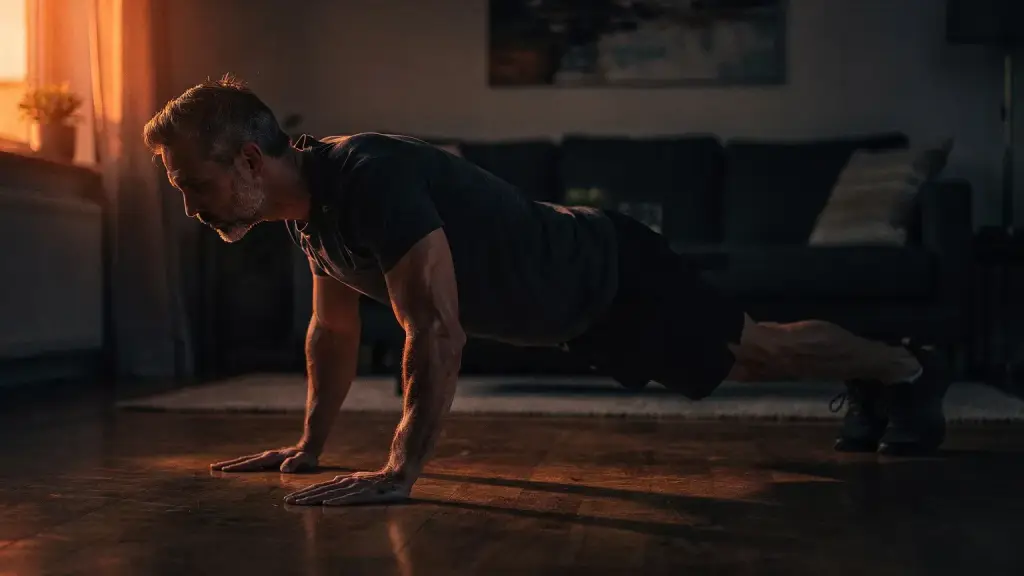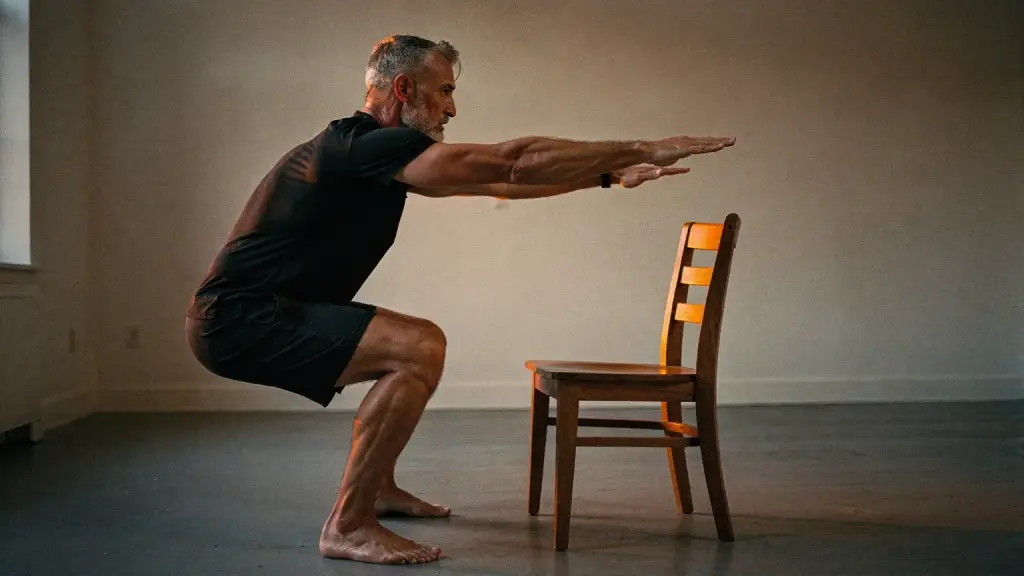

No, 50 is not too late. Men in their fifties still build real strength and muscle with bodyweight training. What changes is power, balance and recovery, so you train a little differently: fewer jumps, more balance work and more protein per meal.
If you’re 52, haven’t trained in years and wonder whether military-style bodyweight training is worth starting, it is. Here’s what changes after 50, two quick tests to see where you stand, and how to adjust the program.
Is 50 too old to start military calisthenics?
No. In a meta-analysis of 47 studies of adults over 50, strength training raised strength by 24 to 33%.(1) The NSCA calls resistance training safe and effective for older adults when it’s progressed sensibly.(2)
Bodyweight training suits this well. There’s no bar to get stuck under, and every move has an easier version. New to the method? Start with what military calisthenics actually is.
The basics of building muscle in midlife are covered in our guide for men over 40. This guide covers what’s different once you pass 50.
What changes after 50?
Strength fades slowly. Three other things change faster, and each one has a simple fix:
| Change | What happens | What to do |
|---|---|---|
| Power | Speed fades before strength | Stand up fast, lower slowly |
| Balance | Drops after the mid-50s | Daily one-leg stands |
| Protein | Muscle needs more per meal | About 0.4 g per kg per meal |
Power is how quickly you produce force, the thing that gets you up the stairs or catches a stumble. It declines earlier and faster than strength.(3) In people aged 65 to 89, leg power dropped about 3.5% a year, against 1 to 2% for strength.(4)
Balance declines quickly after the mid-50s, which is why falls become more common later in life.(5)
Protein works less efficiently. Older men needed about 0.4 g per kg of body weight in one meal to build muscle at the maximum rate, against 0.24 g for young men.(6)
Should you see a doctor first?
Most healthy men can start light and build up. The American College of Sports Medicine advises medical clearance first if you’re inactive and have heart, metabolic or kidney disease, or symptoms of one.(7)
Where do you stand? Two 1-minute tests
Do both before Day 1, with a sturdy chair within reach, and write down your results.
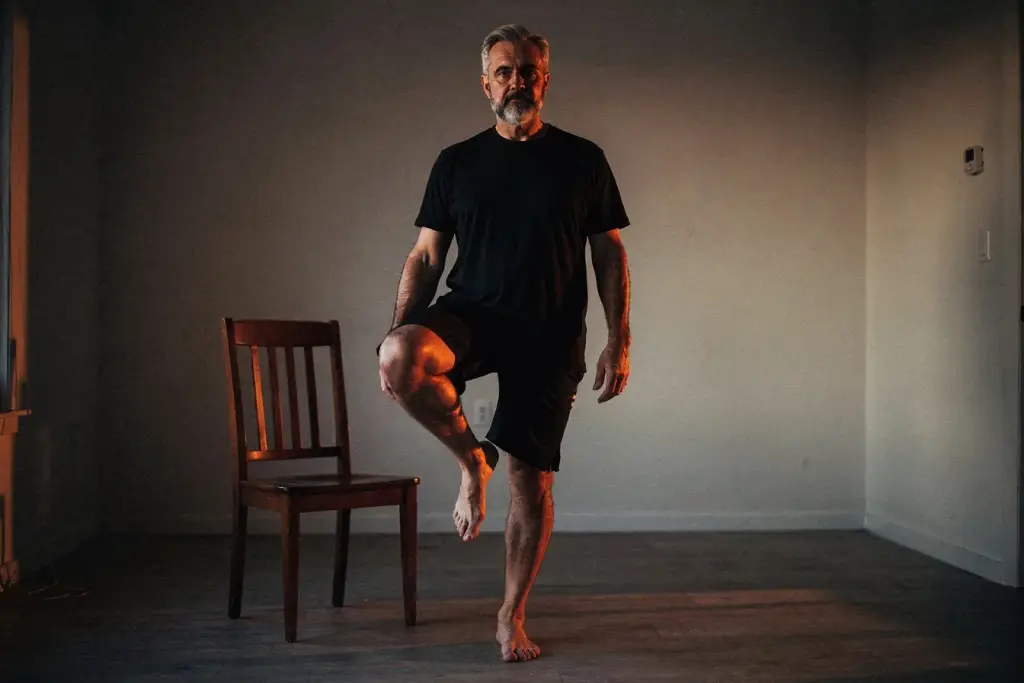
- One-leg stand. Stand on one foot for 10 seconds without holding on, other foot lifted behind you. Try each side.
- Sit to the floor and back up. Score 10, then lose a point for each hand, knee or forearm you use to get down or up. Skip this one if your knees or hips hurt.
Both tests track with long-term health. In 1,702 people aged 51 to 75, those who couldn’t hold a 10-second one-leg stand had an 84% higher risk of death over about seven years.(5)
In 2,002 adults aged 51 to 80, each extra point on the floor test was linked to 21% better survival.(8) These are associations, not proof that practising the tests adds years. But both improve with training, and they’re quick to retest every two weeks.
How should men over 50 adjust the program?
Same program, four adjustments:
- Never skip the warm-up. Each session already opens with two and a half to four and a half minutes of mobility.
- Swap the jumps for the first month, using the table below.
- Train power safely. Stand up from each squat fast, then lower slowly over two to three seconds.
- Stop two reps early. If you’re still sore 48 hours later, take an extra easy day and walk.
| Program move | Start with | Why |
|---|---|---|
| Jump squats | Bodyweight squats | No landing |
| Jump lunges | Reverse lunges, chair for balance | Support while you learn |
| Burpees | No-jump burpees | Easier on knees |
| High knees run | Marching in place | Easier on calves |
| Push-ups | Knee push-ups | Build to 15 clean reps |
| Handstands | Pike hold or forearm plank | No head-down load |
Keep the balance work. The skills days in Weeks 1 and 2 include single-leg balance; from Week 3 they move to handstand drills. If head-down work isn’t for you, do single-leg balance and planks on those days instead.
That matters: in 59 trials of people over 60, exercise cut the rate of falls by 23%, and balance and functional exercises by 24%.(9) The WHO recommends balance and strength training on at least three days a week from age 65.(10)
Is it safe with high blood pressure?
If your blood pressure is controlled and your doctor is happy, exercise generally helps. A review of 270 trials found every type of training lowered resting blood pressure.(11)
Holding positions worked best. Isometric training, like wall sits and planks, lowered it by about 8/4 mmHg, and the wall sit ranked as the most effective single exercise for systolic pressure.(11) The program already includes both.
One rule matters: breathe the whole time. Holding your breath while straining spikes blood pressure. If you have high blood pressure or eye-pressure problems, skip head-down moves like handstands until your doctor clears them.
How do you recover and eat after 50?
- Get protein into every meal. For an 80 kg man, 0.4 g per kg is about 32 g a meal, roughly one chicken breast.
- Sleep seven hours or more, the adult minimum sleep experts recommend.(12)
- Walk on easy days. It eases stiffness better than sitting still.
- Stop on sharp or joint pain. Swap the move for its easier version.
Three meals like that plus a protein snack come to about 1.6 g per kg a day, where muscle gains tend to level off.(13) Our calisthenics nutrition guide keeps meals simple.
What results can you expect after 50?
Reps climb within two to three weeks, mostly because your nervous system is learning the moves. The scale and tape usually start moving in four to six weeks, if you’re eating sensibly.
Visible change in muscle and body fat takes 8 to 12 weeks. Your balance and floor-test scores often improve first, so retest them on Days 14 and 28.
Sessions run 10 to 21 minutes, with six focused days and a total-body endurance day each week. The full structure is in the 28-day military calisthenics plan.

Start at 50-something, at your pace. Open Military Calisthenics Men – MLT, press play, and a real instructor walks you through your first 15-minute session. The app picks the level, the timing and the next step.
Try 3 days freeThen $29.99 a year. Cancel anytime.
 For women: Military Calisthenics Women – HQ→
Frequently asked questions
Is 50 too old to start military calisthenics?
No. Adults over 50 gain strength and muscle from resistance training, including bodyweight work. Start with the easier versions of each move, warm up every session, add balance practice and build up over the first month.
Can a man over 50 build muscle with bodyweight exercises?
Yes. Studies of adults over 50 show resistance training raises strength by roughly a quarter to a third and adds lean mass. Push-ups and squats count, as long as they get harder over time and you eat enough protein.
How many days a week should a man over 50 train?
The program uses six short focused days and one total-body endurance day. If you’re still sore 48 hours later, take an extra easy day and walk. The WHO recommends balance and strength work on at least three days a week from age 65.
What are the best exercises for men over 50?
Squats, push-ups at your level, planks and single-leg balance. Squats train the legs you need for stairs and chairs, and balance work lowers the risk of falls. Stand up from each squat quickly to keep your power.
Should men over 50 do burpees and jump squats?
Not at first. Use no-jump burpees and regular squats for the first month. Add jumping only if your knees, hips and Achilles feel solid and landing is smooth and pain-free.
Is military calisthenics safe with high blood pressure?
If it’s controlled and your doctor agrees, usually yes, and exercise tends to lower it. Breathe throughout every hold, never strain while holding your breath, and avoid head-down moves like handstands until you’re cleared.
Sources
- Peterson MD, et al. (2010). Resistance exercise for muscular strength in older adults: a meta-analysis. Ageing Res Rev.
- Fragala MS, et al. (2019). Resistance training for older adults: position statement from the NSCA. J Strength Cond Res.
- Reid KF, Fielding RA. (2012). Skeletal muscle power: a critical determinant of physical functioning in older adults. Exerc Sport Sci Rev.
- Skelton DA, et al. (1994). Strength, power and related functional ability of healthy people aged 65-89 years. Age Ageing.
- Araujo CG, et al. (2022). Successful 10-second one-legged stance performance predicts survival in middle-aged and older individuals. Br J Sports Med.
- Moore DR, et al. (2015). Protein ingestion to stimulate myofibrillar protein synthesis requires greater relative protein intakes in healthy older versus younger men. J Gerontol A Biol Sci Med Sci.
- Riebe D, et al. (2015). Updating ACSM's recommendations for exercise preparticipation health screening. Med Sci Sports Exerc.
- Brito LB, et al. (2014). Ability to sit and rise from the floor as a predictor of all-cause mortality. Eur J Prev Cardiol.
- Sherrington C, et al. (2020). Exercise for preventing falls in older people living in the community: an abridged Cochrane systematic review. Br J Sports Med.
- World Health Organization. (2020). WHO guidelines on physical activity and sedentary behaviour. WHO.
- Edwards JJ, et al. (2023). Exercise training and resting blood pressure: a large-scale pairwise and network meta-analysis of randomised controlled trials. Br J Sports Med.
- Watson NF, et al. (2015). Recommended amount of sleep for a healthy adult: a joint consensus statement of the AASM and SRS. Sleep.
- Morton RW, et al. (2018). A systematic review, meta-analysis and meta-regression of the effect of protein supplementation on resistance training-induced gains in muscle mass and strength. Br J Sports Med.