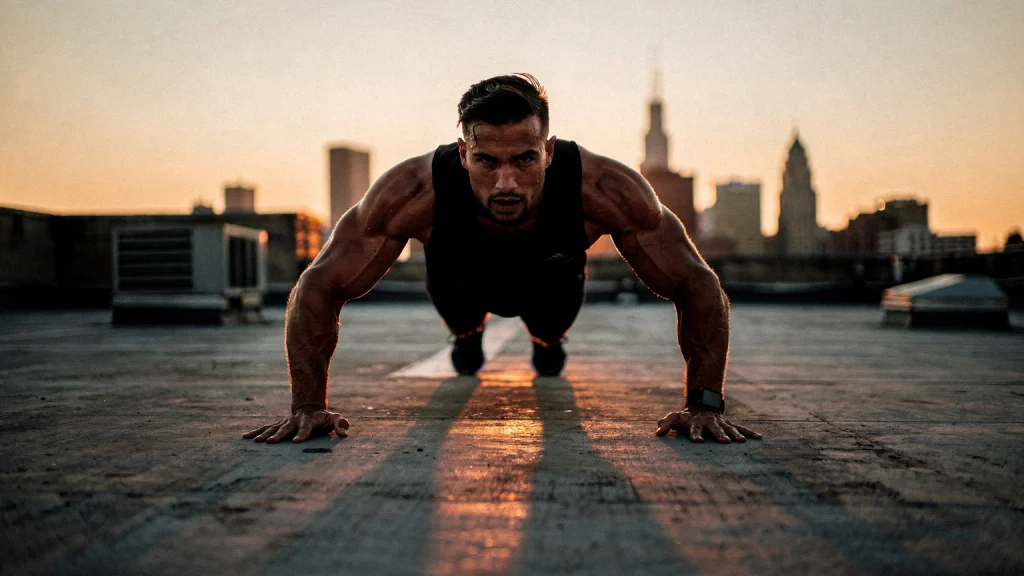
You can build muscle at home with no equipment by making bodyweight exercises progressively harder, taking sets close to fatigue, training each muscle about twice a week and eating enough protein. Those four rules matter far more than the tools.
Here’s how to apply each one in your living room.
Can you really build muscle without weights?
Yes. A meta-analysis found that light and heavy loads build similar muscle when sets are taken close to failure.(1) Bodyweight training is light-to-moderate load.
Studies directly comparing push-ups with bench press found similar gains in muscle size and strength.(2) Your muscles respond to effort, not to the equipment.
Rule 1: Make it harder over time
This is the rule people skip, and why many home workouts stop working after a month. Use one of these each week:
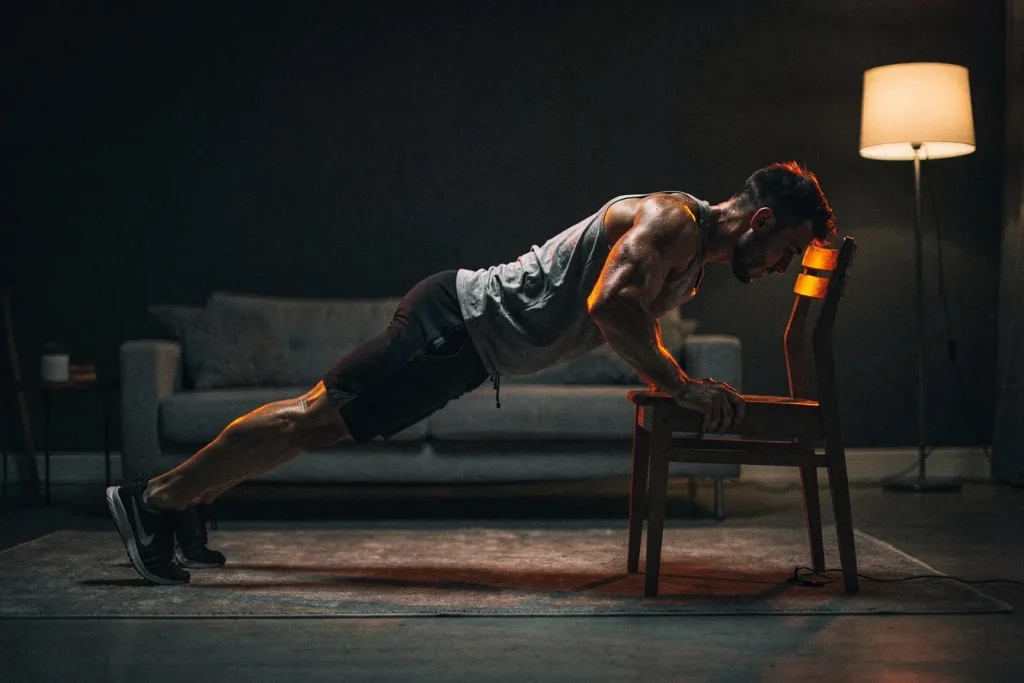
- Harder variation: incline → standard → decline push-up
- Slower reps: three seconds down, one second up
- More reps or rounds at the same difficulty
- Less rest between sets
- Pauses at the hardest point
Even four weeks of progressive push-ups improved bench-press strength in moderately trained men.(3) See our push-up progression for a step-by-step ladder.
Rule 2: Train close to fatigue
Finish most sets with one or two reps left. If you could do ten more, the set is too easy to build muscle.
That’s why bodyweight sets often look high-rep. Twenty hard push-ups can be as effective as eight hard bench-press reps.
Rule 3: Hit each muscle about twice a week
A meta-analysis found training each muscle at least twice a week built more muscle than once a week.(4)
You don’t need long workouts to do this. Short daily sessions that rotate muscle groups hit everything twice. A push-pull-legs split is one easy way.
Rule 4: Eat enough protein
Muscle is built from protein. Most people training regularly do well on 1.4 to 2.0 g per kg of body weight daily.(5) Benefits level off around 1.6 g/kg.(6)
For a 75 kg person, that’s about 120 g a day. Read our calisthenics nutrition guide.
What does a week of home muscle training look like?
| Day | Focus | Key moves |
|---|---|---|
| 1 | Push | Push-ups, pike push-ups, chair dips |
| 2 | Pull & posterior | Table rows, back extensions, glute bridges |
| 3 | Legs | Squats, lunges, single-leg bridges |
| 4 | Upper conditioning | Push-up variations, plank to push-up |
| 5 | Full body | Burpees, jump squats, mountain climbers |
| 6 | Skill & core | Pike holds, planks, leg raises |
| 7 | Rest or walk | — |
This is the same structure used in the military calisthenics workout plan.
What’s the hardest part to train without equipment?
Your back and your legs once you get strong. For the back, use rows under a sturdy table and towel rows. For legs, slow single-leg work and pauses.
More ideas: back exercises without a pull-up bar and the full exercise list.
How long until you see muscle?
Strength rises in two to four weeks. Visible muscle usually takes eight to twelve weeks of consistent training and enough protein. Compare the options in calisthenics vs gym.
Progression built in. Just press play. MLT puts the whole 28-day program on your iPhone, with every session led on video by a real calisthenics instructor. No gym, no equipment, 10–21 minutes a day.
Try 3 days freeThen $29.99/year. Cancel anytime in iPhone Settings.
For women: the HQ edition
Frequently asked questions
Can you build muscle at home without equipment?
Yes. Bodyweight exercises build muscle when they get progressively harder, sets are taken close to fatigue and you eat enough protein. Studies show results similar to weights.
How many push-ups a day to build muscle?
There’s no magic number. Do a few hard sets close to failure, two to three times a week, and make them harder over time. Daily easy push-ups won’t build much.
How long does it take to build muscle at home?
Expect strength gains in a few weeks and visible muscle in about 8 to 12 weeks with consistent training and enough protein.
What is the best home exercise for building muscle?
The push-up for the upper body and the squat or lunge for legs. Rows and back extensions balance them out.
Sources
- Schoenfeld BJ, et al. (2017). Strength and hypertrophy adaptations between low- vs. high-load resistance training: a systematic review and meta-analysis. J Strength Cond Res.
- Kikuchi N, Nakazato K. (2017). Low-load bench press and push-up induce similar muscle hypertrophy and strength gain. J Exerc Sci Fit.
- Kotarsky CJ, et al. (2018). Effect of progressive calisthenic push-up training on muscle strength and thickness. J Strength Cond Res.
- Schoenfeld BJ, Ogborn D, Krieger JW. (2016). Effects of resistance training frequency on measures of muscle hypertrophy: a systematic review and meta-analysis. Sports Med.
- Jäger R, et al. (2017). International Society of Sports Nutrition position stand: protein and exercise. J Int Soc Sports Nutr.
- Morton RW, et al. (2018). A systematic review, meta-analysis and meta-regression of the effect of protein supplementation on resistance training-induced gains in muscle mass and strength. Br J Sports Med.